Car Rental in Denmark: A Practical Guide to Prices, Rules and Booking
Planning a trip to Scandinavia and wondering whether you need your own set of wheels? Car rental in Denmark is surprisingly affordable compared with neighbouring Norway and Sweden, and for many travellers it is the easiest way to reach places the trains skip. Prices for a compact car typically start around 250 to 350 DKK per day (roughly €34 to €47) if you book early, and the country’s compact size means you can drive from Copenhagen to the German border in under three hours. This guide covers real costs, driving rules, the best rental companies, and the mistakes that catch first-time visitors out.
How much does car rental in Denmark actually cost?
Denmark sits in the middle of the Scandinavian price range. Cheaper than Norway, slightly more than Germany. In peak summer season (June to August), expect to pay 400 to 600 DKK per day for a compact car such as a Volkswagen Golf or similar, while off-season winter rates can drop to 200 to 300 DKK per day for the same vehicle if you book two or three weeks ahead.
One-way rentals add cost. Picking up in Copenhagen and dropping off in Aarhus usually adds 500 to 900 DKK, depending on the company. Cross-border drop-offs, for example picking up in Denmark and returning in Germany, can be far pricier and not every supplier allows it, so check the terms before you book.
Insurance is where budgets often blow out. Basic quotes look cheap but come with a high excess, often 6,000 to 10,000 DKK. Collision damage waiver (CDW) and theft protection reduce this, but
 the most economical option for most travellers is a standalone excess insurance policy from a third-party provider, which typically costs 30 to 50 DKK per day and covers the deductible on almost any rental agreement.
Which rental companies operate in Denmark?
The major international brands all have a presence: Hertz, Avis, Europcar, Sixt, Budget and Enterprise. At Copenhagen Airport you will find most of them clustered in the arrivals area, alongside rental brokers like Sunny Cars and local operators such as Citroën-affiliated Green Motion alternatives and Danish firm Lej At Køre.
- Budget and Avis: good coverage in Jutland cities like Aalborg, Aarhus and Esbjerg.
- Europcar: strong network including smaller towns and often flexible one-way options.
- Sixt: competitive on automatic cars, useful since Denmark has more automatics than you might expect.
- Hertz: reliable at Copenhagen, Billund and Aarhus airports, often pricier but consistent.
- Sunny Cars: a broker that bundles all-inclusive insurance, popular with German and Dutch tourists.
Booking through comparison sites such as Kayak, Rentalcars or DiscoverCars almost always beats walking up to a counter, especially in July when Danish holiday demand spikes.
Do you need a car in Denmark at all?
Honest answer: not always. Copenhagen, Aarhus and Odense have excellent public transport, and cycling culture means many locals never drive. But a rental car pays off if you want to explore the places trains reach slowly or not at all.
Where a car genuinely helps
The Danish Riviera along northern Zealand, with Kronborg Castle at Helsingør and the Louisiana Museum of Modern Art at Humlebæk, is easy by coastal train. But the white cliffs of Møn, the Wadden Sea National Park on the southwest coast, the beaches near Skagen at the very top of Jutland, and the rolling hills around Silkeborg are far more enjoyable with your own car. Rømø and Fanø, two of the Wadden Sea islands, are reachable by causeway, so you can drive right onto the beach at Rømø, one of the few places in Europe where that is legal.
Copenhagen versus Billund pickup
Most visitors fly into Copenhagen (CPH), but Billund (BLL) is worth considering if Legoland is on your itinerary or if you plan to focus on Jutland. Rental desks there are small but competition keeps prices reasonable, and you avoid the traffic around the capital.
What are the driving rules you should know?
Denmark drives on the right. Speed limits are 50 km/h in towns, 80 km/h on rural roads and 130 km/h on motorways, though some motorway sections are signed at 110 km/h. Speed cameras are common and fines are steep, starting around 1,500 DKK for modest violations.
Headlights must be on at all times, day and night, and rental cars come with this set automatically. A warning triangle and hi-vis vest are legally required, and all rentals include them. The blood alcohol limit is 0.5, lower than in many countries, so plan for zero drinks if you are driving.
Watch for cyclists. Danish drivers check for bikes before turning right, and you should too. Copenhagen and Aarhus have extensive cycle lanes, and rental car drivers who forget them cause a large share of tourist accidents. When parking, blue-zone discs are needed in some towns and most cities use pay-and-display apps such as EasyPark.
How do bridges, ferries and tolls affect your budget?
Denmark’s two major bridge crossings are not free. The Storebælt Bridge linking Funen and Zealand costs 275 DKK each way for a standard car (2024 pricing), and the Øresund Bridge between Copenhagen and Malmö in Sweden costs around 460 DKK one way. Both offer discounts for frequent users via number-plate-based BroPas accounts, but tourists simply pay at the toll booth or automatically by plate registration.
Ferries matter too. If you want to visit Bornholm, the Baltic island beloved by Danish holidaymakers, the ferry from Ystad in Sweden (reachable via the Øresund Bridge) costs roughly 400 to 600 DKK return for a car plus driver, and the crossing takes about an hour with the express catamaran. The Langeland and Als crossings have been toll-free since 2013, so driving around the southern archipelago costs nothing extra.
| Crossing | Type | Cost per car (one way) |
|---|---|---|
| Storebælt Bridge | Bridge | 275 DKK |
| Øresund Bridge | Bridge | 460 DKK |
| Rønne to Ystad (Bornholm) | Ferry | 400-600 DKK |
| Langeland Ferry | Ferry | Free |
Fuel prices hover around 14 to 16 DKK per litre for 95 octane petrol, and diesel is usually a krone or two cheaper. Distances are short, so even a week of driving rarely burns more than 1,200 DKK of fuel.
How old do you need to be, and what documents are required?
The minimum age for most Danish rentals is 21, with a licence held for at least one year. Drivers under 25 usually pay a young driver surcharge of 75 to 150 DKK per day. Some categories, such as premium cars and vans, require drivers to be 25 or older.
EU licences are accepted without any extras. Non-EU visitors can drive on their national licence for up to 90 days, though an International Driving Permit is recommended if your licence is not in Latin script. You will need a credit card in the main driver’s name for the deposit, which is typically blocked at 1,000 to 3,000 DKK depending on your excess level. Debit cards are accepted by some suppliers but often with stricter conditions.
What is the best time to book a rental car in Denmark?
Book four to eight weeks ahead for summer travel. Prices in July and early August climb fast once school holidays start in late June, and automatic cars are the first to sell out. For travel between October and March, booking two weeks ahead is usually enough, and prices are at their lowest in January and February, when a compact car can occasionally be found for under 200 DKK per day.
Pickup location matters for price. Downtown Copenhagen offices are often 10 to 15 percent cheaper than the airport desks, and there is a metro link from the airport to the city centre in under 15 minutes, so the saving costs you almost no time.
FAQ about car rental in Denmark
Can I take a rental car from Denmark to Sweden or Germany?
Yes, in most cases. Cross-border travel within the EU is permitted by Hertz, Avis, Europcar, Sixt and Enterprise, but you must inform the rental company in advance and you remain liable for tolls. Some smaller local firms restrict crossings, so read the rental conditions or ask before booking.
Is parking difficult in Copenhagen?
It can be. Central Copenhagen parking costs up to 46 DKK per hour in the most expensive zones, and free street parking is scarce. Use the EasyPark app, park in a suburban P+R facility, or choose a hotel with parking included. Many visitors park the car at the hotel and use the metro for city sightseeing.
Are electric cars available to rent?
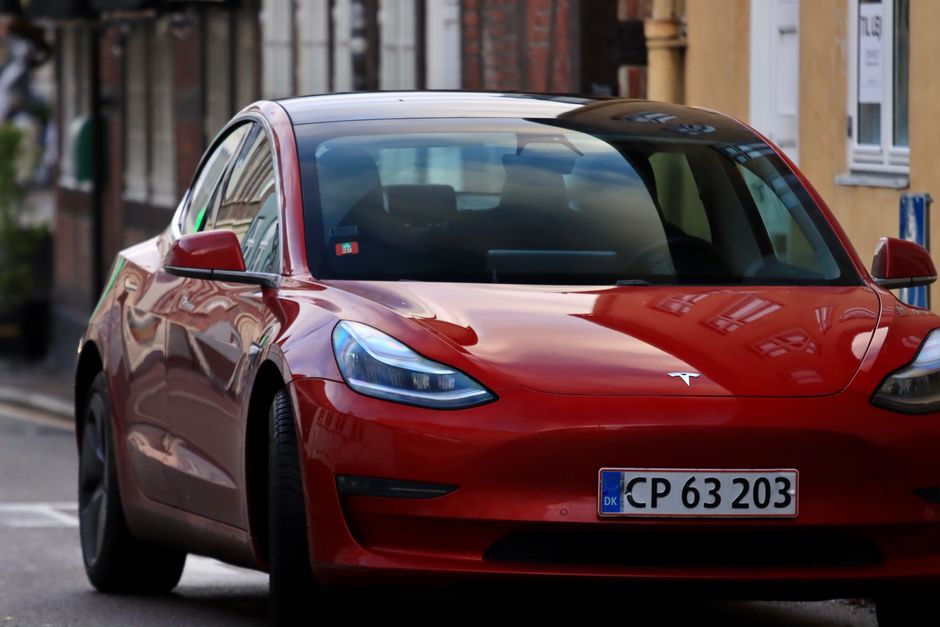
Increasingly, yes. Sixt and Hertz both offer EVs such as the Polestar 2 and Tesla Model 3 at Copenhagen and Aarhus locations, often at similar prices to petrol equivalents. Denmark has a solid charging network, and many chargers are free at supermarkets and hotels.
Do child seats cost extra?
Almost always. Expect 60 to 100 DKK per day per seat from the major companies, and availability is limited in summer, so reserve in advance. Bringing your own seat on the flight is often cheaper for trips longer than three days.
Final thoughts
Car rental in Denmark makes sense the moment your itinerary leaves the big cities. Costs are moderate, roads are excellent, distances are short, and the countryside rewards drivers with cliff walks, beach driving at Rømø and quiet villages the tour buses never reach. Book early if you are travelling in summer, sort out your excess insurance before you arrive at the counter, and budget for the Storebælt toll if you are crossing between the islands. Do those three things and the rest of the trip takes care of itself.